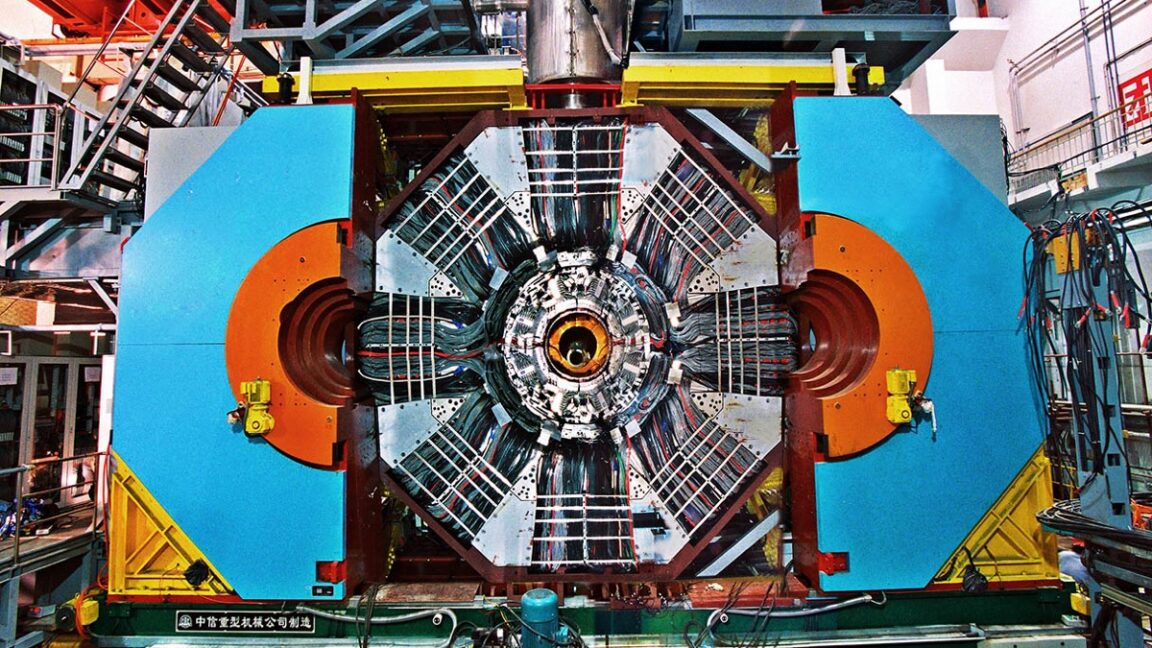
ROME: Physicists involved with the Beijing Spectrometer III (BES III) experiment have reportedly uncovered compelling evidence for the existence of glueballs, a theoretical composite particle made entirely of gluons. These findings, which were initially shared on arXiv and presented at the International Conference on High Energy Physics, could confirm a crucial prediction of quantum theory. The concept of glueballs stems from quantum chromodynamics, the theory describing the strong nuclear force. While the discovery of the Higgs boson in 2012 was a significant milestone for the Standard Model of Particle Physics, questions about the existence of glueballs have persisted.
These particles, if proven to exist, would represent pure force without matter, composed only of the gluons that also bind quarks together in protons and neutrons. The detection of glueballs would validate a long-standing prediction of quantum chromodynamics, suggesting that several types of these particles should exist. This discovery could further refine our understanding of the fundamental forces governing the universe. The broader implications of confirming glueballs extend to enhancing the Standard Model's accuracy and possibly unveiling new physics beyond our current theoretical framework.
Researchers anticipate that further studies and experimental confirmations will be necessary to solidify these initial findings.
Image credit: ARS TECHNICA